
From the Track of This Famous Hippodrome, Not a Single Journalist Will Be Missing. Inexorable Death Has No Respect, Not Even for Those You See Here Riding Bicycles.
<p>The mainstream press was also a target in Posada’s day. This satirical broadside shows bicycle-riding <em>calaveras</em> representing various newspapers who compete in a headlong race. Comically and symbolically attired, the competitors include the Roman Catholic daily <em>El Tiempo</em>, who wears a mitre and appears as Father Time, and <em>El Partido Liberal</em>, who wears a Phrygian cap.</p> <p><strong>Español:</strong><br>La prensa dominante fue también objeto de duras críticas durante la época de Posada. Esta satírica hoja volante muestra a un grupo de calaveras en bicicletas. Cada una representa a un periódico particular compitiendo desesperadamente en una apurada carrera. Ataviados con vestimentas cómicas y simbólicas, entre los competidores se encuentran el diario católico El Tiempo, que luce una mitra y cuya imagen remite a la figura del mítico padre del tiempo Cronos, y El Partido Liberal, que porta un gorro frigio.</p>
Catalogue
- Year
- 1895
- Dimensions
- 60.1 × 40.5 cm (23 11/16 × 16 in.)
- Collection
- Art Institute of Chicago
- Artist
- José Guadalupe Posada
Artist

Printmaking
José Guadalupe Posada was a Mexican printmaker and illustrator whose satirical engravings and lithographs became the visual language of Mexican popular culture in the late 19th and early 20th centuries. Working primarily in zinc etching and relief printing, he produced thousands of broadsheets, handbills, and book illustrations that merged political commentary with skeletal imagery, most memorably the calaveras that would later define Día de Muertos visual tradition. His prolific output served the Mexican working class and political movements, circulating images of social critique and vernacular wit through affordable prints distributed in markets and streets. Posada's formal inventiveness with line, pattern, and grotesque figuration established visual conventions that would influence Mexican modernism and printmaking internationally.
Full artist profile →More
More by José Guadalupe Posada

Calavera of Francisco Madero, from Calavera Maderista
1944 · Relief etching from a zinc plate on grayish-ivory China paper
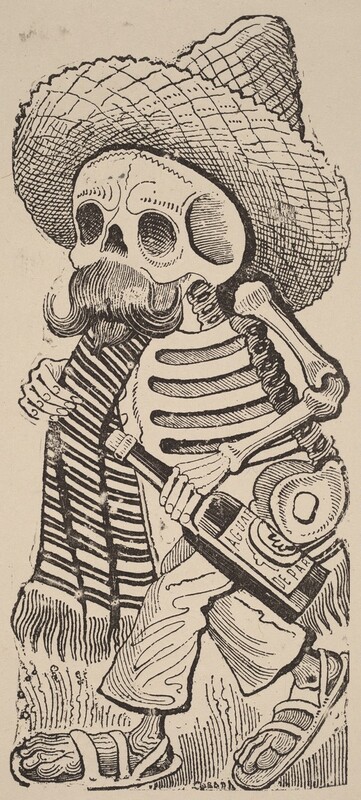
Calavera of Francisco Madero, from Calavera Maderista
1944 · relief etching (zinc) on China paper

Calavera of Francisco Madero, from Calavera Maderista
1944 · Relief etching from a zinc plate on grayish-ivory China paper

Calavera of Francisco Madero, from Calavera Maderista
1944 · Relief etching from a zinc plate on grayish-ivory China paper

Calavera of Francisco Madero, from Calavera Maderista
1944 · Relief etching from a zinc plate on ivory Japanese paper

The Medical Consultation (El Consultorio Medical) from 25 Prints of José Guadalupe Posada
1942 · Etching from a portfolio of seventeen engravings and eight etchings
Record
Verified by WattsOS- Artist
- José Guadalupe Posada
- Year
- 1895
- Dimensions
- 60.1 × 40.5 cm (23 11/16 × 16 in.)
- Watts ID
- WW-1895-088498
Source
- Collection
- Art Institute of Chicago
- Source
- aic
- Reference
- View at source
- Status
- verified