New Exhibition Exploring Azzedine Alaïa’s Fascination with Africa Opens
By Roxanne Robinson
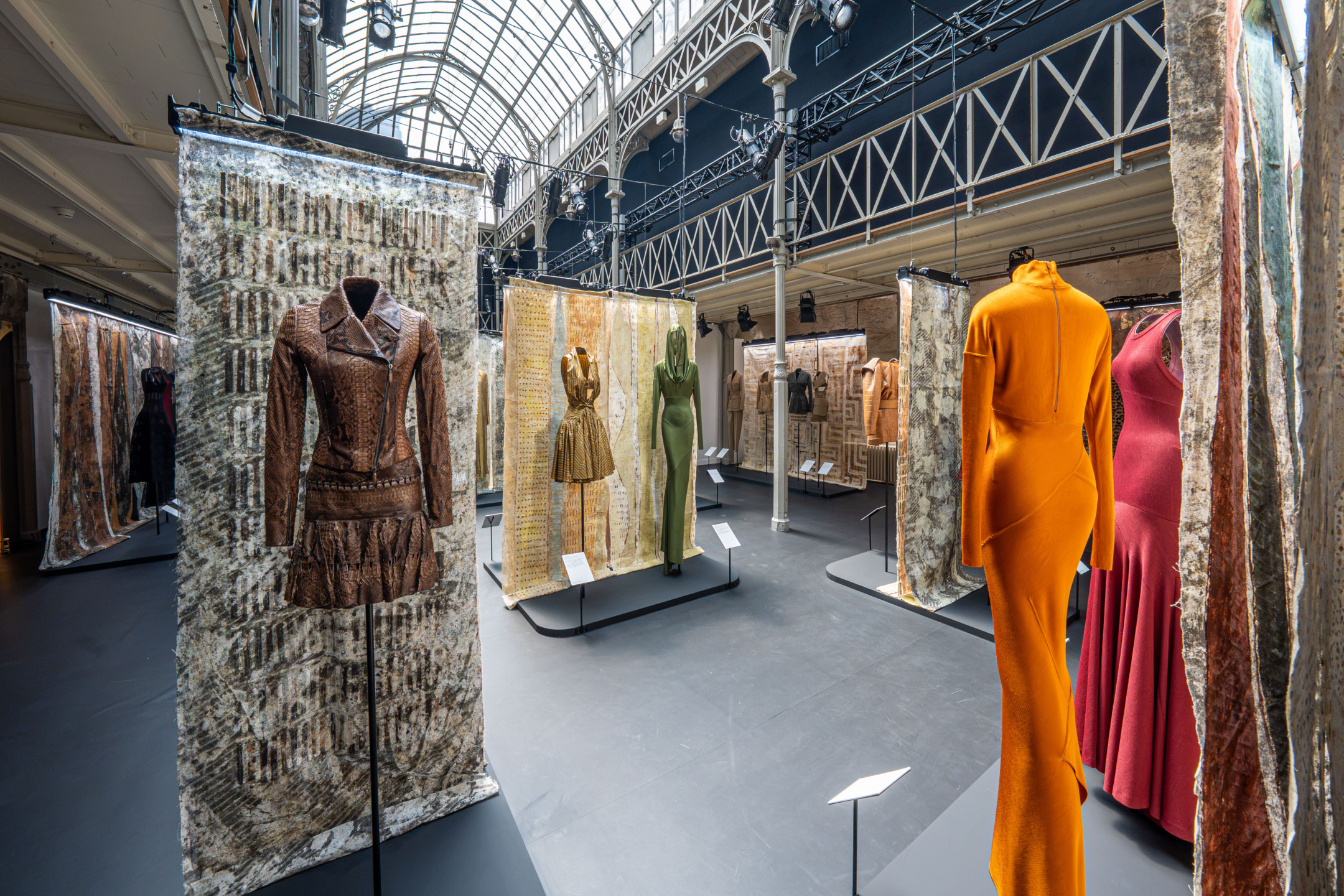
Azzedine Alaïa left his native Tunisia at 21 for Paris, where he lived until he died in 2017. However, the country of his birth and the continent of Africa were omnipresent in the designer’s spirit and fascination. The latest exhibition at the Fondation Azzedine Alaïa in Paris, “Azzedine Alaïa and Africa,” curated by Olivier Saillard—the foundation’s president, alongside Carla Sozzani—explores the rich cultural influence that imbued the couturier’s work, following a trip to the continent with renowned photographer Peter Beard.
The exhibit opens with the designer’s nostalgia for the mashrabiya, carved-wood latticework over windows, designed to help cool buildings from the intense African sun in Tunisia and elsewhere. These are translated in various ways on garments, whether woven into fringed leather or laser-cut in white cotton.
According to Saillard, it was one way the continent inspired designs that were not clichéd, and he noted that Alaïa’s imagination also extended beyond Tunisia.
“For many people, African fashion means what Saint Laurent did with Moroccan-influenced styles, but for Azzedine, it meant Tunisia, Egypt, and Sub-Saharan Africa, not just the caricature of African,” the curator said.
That said, a large portion of the work comes from collections made in 1988, 1989, and 1990, and features details of the large and diverse continent. Highlights include a rope-fringe-trimmed red bustier dress, a pony skin and horsehair fringe dress, shell beading on an elastane knit skirt and bra set, completed with an open-construction safari cargo vest, a red python wrap dress, and a metallic gold evening openwork gown befitting Cleopatra’s breastplate necklaces or the Dzilla rings worn by the Ndebele people of Southern Africa.
Saillard distinguished Alaïa’s use of black as specific to the continent. “It’s not a black that a Belgian designer, for example, would use. It very much belonged to Azzedine. I tried to see how Africa was in the back of his mind,” he said. Fine ebony knits trimmed with raffia tassels, or a tailored tailcoat with a crocodile-skin appliqué, are Exhibit A. Even the bandage dress, also on display, owes its due to Egyptian queens and pharaohs.
The curator had to imagine the late designer’s thoughts, since Alaïa was not a traveler. “He used to say he traveled in his chair,” Saillard continued, referring to his drafting table and sketch pad.
However, he did take one unforgettable trip with the photographer Peter Beard—hence the seminal styles that followed, starting in 1988—at the behest of Elle France in 1986. The duo and crew traveled through the Turkana lands among the Samburu, a closely related tribe to the Maasai. The resulting editorial and artifacts of its creation are also on display. Beyond the culture, clothes, and accouterments, Alaïa was struck by the simple yet elegant gesture of the people, who said, “They have the most noble way to walk.” Alaïa’s 90s supermodels—side bonus treat: naming them—featured in the exhibit via an archive of runway footage captured it perfectly.
“Azzedine Alaïa and Africa,” is open from July 7th, 2026 to January 4th, 2027 located at Fondation Azzedine Alaïa 18, rue de la Verrerie, 75004 Paris.
This article was originally published by Galerie Magazine.