Chef Fadi Kattan Is Feeding the Venice Biennale While Bethlehem Has No Tourists Left
By By Mina Stone
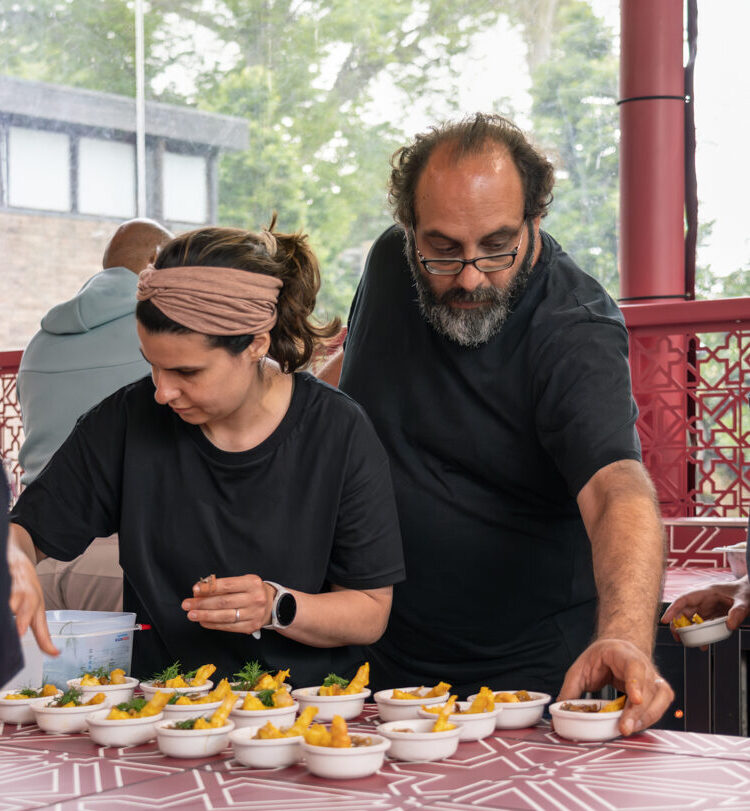
Cooking is an art. That fact has never been more evident than in the prominent position food occupies at the National Pavilion of Qatar at the Venice Biennale. The only pavilion with an ongoing food program invites a rotating cast of chefs from the MENA region to present experimental dishes that reflect histories of trade and exchange alongside similarly eclectic film and music programs.
At the helm of the food offering is Fadi Kattan, a Palestinian chef and author of Bethlehem: A Celebration of Palestinian Food. He is also the owner of the restaurants akub in London and louf in Toronto. Kattan was invited by curators Ruba Katrib and Tom Eccles to participate in the pavilion designed by Rirkrit Tiravanija and commissioned by Sheikha Al-Mayassa bint Hamad bin Khalifa Al Thani in a project aptly given the subheading “A Gathering of Remarkable People.”
Fadi exudes the remarkable. He is animated, boisterous, and a thoughtful poet when he speaks about food. He often smooths his beard as he tenderly explains how his spice monger in Bethlehem has encyclopedic knowledge of every family’s specific seven-spice blend. This relationship between purveyor and customer—intimate, informed by history, rooted in place—shaped Fadi’s own approach to cooking.
Throughout the Biennale’s run, the pavilion will offer themed music and food pairings, such as field recordings captured by Tarek Atoui from Qatar’s coastline coupled with street foods reflecting Doha’s multicultural culinary landscape. I am especially excited by October’s poetry-led performances accompanied by an exploration of coffee as a cultural cornerstone of Arabic hospitality.
Fadi’s work at the Biennale, as well as his cookbooks and restaurants, offer a clear picture of hospitality’s ultimate purpose: to remind us of our shared humanity. Below, I speak to Fadi about the inspiration for the project as well as the mouth-watering, lemony malfouf cooking during our chat.
This is the way we start many interviews: What did you eat for breakfast?
Fried eggs, sumac on top, and nice warm Palestinian pita bread. A bit of labneh and Nabulsi cheese.
We’re both in very ancient cities right now. I’m in Athens and you are in Bethlehem. What’s it like there?
It’s an interesting place and a sad place because of the political realities. It would be great if it were treated like any other ancient city across the world, but it’s not. I came back yesterday from London, and when you drive into the city, you have the very symbolic, very ancient core of the old city of Bethlehem. That’s where I live; I’m lucky to live there.
We tend to, in our imaginations, start Bethlehem at the year zero, but it starts way before the year zero. It’s not the birth of Christ that started Bethlehem; it’s the Canaanites and the Israelites and the Phoenicians and everyone else 10,000 years before the year zero. What hits you is a 12-meter-high wall built by Israelis in the middle of the city. What hits you is 26 settlements built on the land of the city. That’s the constant contradiction of this ancient city that should be glorified.
Your work in the Venice Biennale is also connected to an ancient city.
When you look at the history of Venice and Bethlehem, there have been church links from way back. A lot of trade also happened. A lot of the artisans of Bethlehem, whether they were working with mother-of-pearl or wood, would export to Venice. Then you realize there’s this dichotomy: in Venice, there’s a program to make the lagoon cleaner. In Athens, there are more and more attempts to limit the impact of massive tourism. And then in Bethlehem, there have been no tourists since the start of the genocide, and you have 65 percent unemployment.
Can you tell me a little bit about your background and the food ecosystem you grew up in? What ultimately sparked your interest in food?
I come from a family that, like a lot of families in Bethlehem, links to a bit of everywhere. My dad was born in Bombay, and then they came back to Palestine in 1954. Then my dad went off and did his studies in the U.K. On that side of the family, my grandfather had seven siblings who ended up all over the world—in Manchester, Santiago de Chile. We had a great aunt in Rome. All of that was reflected in food.
On my mother’s side, my grandfather was born in Bethlehem, grew up in Paris, and then came back to Bethlehem, so he was very Francophile. My grandmother was a prominent actress of the social and humanitarian world and she set up the first museum in Bethlehem, the first women’s union in the city. I grew up having curry involtini and Palestinian musakhan all at the same time.
Those influences gave me a very Palestinian but also very cosmopolitan food world. I was exposed to the stories because the stories were important. It wasn’t simply, “Oh, we’re cooking Italian food today.” It was the story of your great-aunt who lived in Rome. One day, I decided to do involtini and I walked into the butcher shop, and I started describing to the butcher how thin I needed the cuts of meat. He looked at me and said, “Oh, are you doing your great-aunt’s recipe?”
How has Bethlehem specifically informed your approach to food?
Part of my obsession with sourcing local comes from Bethlehem. The spice shop, owned by a man named Tewfic Lama, still has a little note from my grandmother with her spice mix. Whenever I walk in, I’m like, “I want a mix of spices.” His first question is, “Oh, do you want Julia’s spices, or do you want to make your own mix?” Julia’s spices are my grandmother’s. But he won’t sell that mix to anybody else, only to the family.
How does he keep track of everyone’s order?
It’s fascinating. His name is Sofilama. He also sells coffee. He knows each family’s blend by heart. A mix of dark and light roast? Adding cardamom or not? I walk in and say, “Can I have some coffee?” And he says, “Is it for you? Or for your parents’ house?” He knows it’s 70 percent dark roast, 30 percent light roast cardamom for me, and for my parents, it’s no cardamom and much more dark roast than light roast. You walk into a bakery here and they will know how baked you want your bread. Bethlehem, at the end of the day, has 35,000 inhabitants. Quite a small town.
Tell me about your involvement in the Venice Biennale and the Qatar Pavilion.
Tom Eccles and Ruba Katrib are the curators for the Qatar Pavillion and they chose to work with three elements that have been present in other events with the Qataris over the last couple years: food, music, and film. It joins Sheikha Al-Mayassa’s idea of Qatar being a place that collects different Arab narratives.
A lot of Arab food is unknown to the world. The approach was to tell people there are food journeys that are way older than what we can imagine. As a Palestinian, a lot of spices I use today came from Persia and India through places like Qatar. The first time I landed in Doha, two things hit me. One was the variety of Arabic accents I was hearing. We’re not in touch with other Arabs. We can’t receive other Arabs because if you’re Lebanese, Syrian, Jordanian, Qatari, etc., you’re not allowed by the Israelis to come to Palestine. So, landing at the airport, that variety of accents was just like, “Wow, wait. I am an Arab. I am part of something bigger that is Arab.”
The other thing that hit me was because of my dad being born in India and having been to India a lot. Doha felt a bit closer to India—the humidity of the sea, the colors, the people of foreign origins. You talk to any Qatari, and they’re very familiar with Indian food, Filipino food, Sudanese food. So that’s also part of the story we’re trying to tell during the Biennale.
Can you tell me about the exploration of coffee as a cultural cornerstone of Arabic hospitality?
Coffee gives the rhythm of hospitality. If you have a grandmother, she would find it outrageous if you visited her and she did not serve coffee. I was told off by enough grandmothers in my region of the world to know that you have to stay for coffee. Coffee links the entire region. While coffee originally came from Yemen, cardamom comes from India.
The history of coffee shops in the Middle East is quite interesting. Coffee shops came from three places: Turkey, Europe, and India. At the turn of the 20th century, coffee shops were the place where political activism was brewing. In a place like Haifa, there were 30 coffee shops in 1905 that were infiltrated by every secret service of the world, listening in on what was happening in this part of the world.
In Palestine, our intellectuals very often talk about coffee. In the Gulf regions, coffee is very much an essential part of those evenings in the desert, where people gather, recite poetry, and spend a few hours in the evening together.
What does your life as a chef look like now?
I’m lucky to have my restaurants, akub in London and louf in Toronto. My first book, Bethlehem, has been very successful. I have another book coming out, hopefully next spring. It’s a cookbook, but it also talks about Palestinian wines and wineries. At the same time, my original restaurant, Fawda, which I opened in Bethlehem in 2015, has been closed since Covid. Then we couldn’t reopen because the genocide started, and I feel a lack of restaurant activity in Palestine because I am based here. Everything I do elsewhere is Palestinian and I feel like I need to be able to do something here.
What is the dish that represents where you are in your life right now?
A dish that represents this is basic warm pita, labneh, a lot of olive oil on top, and za’atar. If we take a more elaborate dish, I am at my parents’ home as we speak, and I can smell what’s cooking for lunch today, which is stuffed cabbage leaves, or malfouf. They are stuffed with rice and meat, and then loads of garlic and lemon juice. So at this instant, this is home. Being anchored here is very much what I feel right now.
More of our favorite stories from CULTURED
The 2026 Young Activists List: Meet 13 Change Agents Nominated by Gloria Steinem, Stacey Abrams, and More
An Exclusive Look Inside the Property That Houses Jorge M. Pérez’s Sweeping Art Collection
How Lillian Bassman’s Groundbreaking Career Reinvented Fashion Photography
Here’s All the Must-See TV Streaming in July
Peak Summer Is Here. Skip the Stove With These Dishes Best Served From the Fridge.
Sign up for our newsletter here to get these stories direct to your inbox.
Sign up for a digital subscription, starting at less than $3 a week.
Sign up for a digital subscription, starting at less than $2 a week.
You’re approaching your limit of complimentary articles. For expanded access, become a digital subscriber for less than $3 a week.
For less than the price of a cocktail, you can help independent journalism thrive.
For less than the price of a cocktail, you can help independent journalism thrive.
You’re approaching your limit of complimentary articles. For expanded access, become a digital subscriber for less than $3 a week.
For less than the price of a cocktail, you can help independent journalism thrive.
Support independent criticism for $10/month (or just $110/year).
This article was originally published by Cultured Magazine.